Most announcements change one line in your account. A ticker goes away, a network pauses for maintenance, a product stops taking new subscriptions. An exit notice works a level above that: it sets a date after which the account stops being a place you can take money out of in the ordinary way.
Three published notices set out different terms. Binance restricted Dutch accounts to withdrawals in 2023. Its 2024 naira notice set separate deadlines for deposits, trading and withdrawals, followed by automatic conversion. The four timestamps examined below span 66 hours. BitMEX's September 2026 closure notice provided for continued withdrawals and fees on remaining balances. A withdrawal deadline can therefore mark a change in terms without ending every route to the funds.
Three ways a venue ends your access
Your jurisdiction loses support
Binance's notice of 16 June 2023 told users resident in the Netherlands that from 17 July 2023 at 00:00 UTC their accounts would allow withdrawals only: “no further purchases, trades or deposits will be possible”. This restriction applied to Dutch residents. Their accounts remained available for withdrawals, but the balances could no longer be used for purchases or trades.
One feature of that notice matters more than the date. The public announcement named the day access narrowed, then pointed affected residents to a separate email for the account-specific part. So an exit notice can hand you a start without handing you an end. When your own final date arrives only in an inbox, the published page stops being the document that governs you, and a missing deadline is worth a support ticket rather than an assumption.
One rail closes, the account keeps running
When Binance discontinued Nigerian naira services (published 5 March 2024, amended 18 June 2024), the subject was a currency rather than a group of customers. Naira deposits, naira trading pairs and naira withdrawals each stopped at their own timestamp while the rest of the account kept working. Rail notices read alarmingly because they borrow the vocabulary of a shutdown. The test runs the other way: check whether the notice names a currency or a network — or names you.
The venue closes
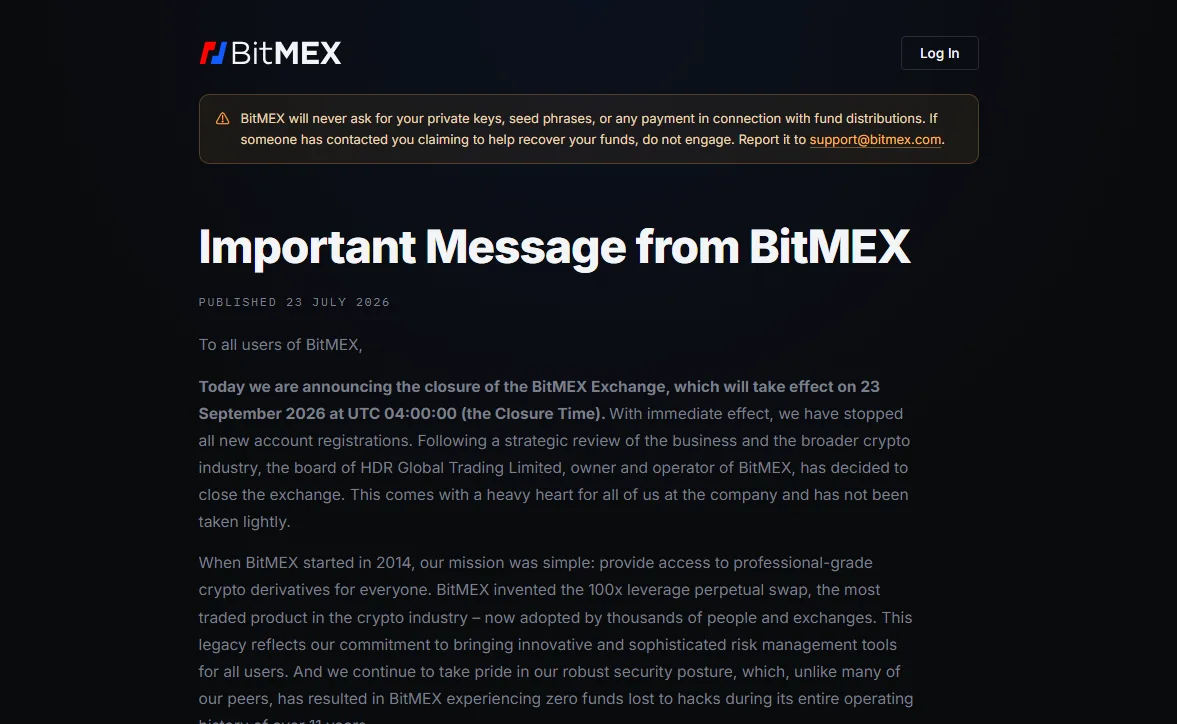
BitMEX announced its closure on 23 July 2026 and stopped registrations immediately. The closure time was 23 September 2026, 04:00 UTC. Reduce-only limits began on 26 August at 04:00 UTC; the notice allowed forced closure of positions during that wind-down as well as at the final cutoff. Login, account history and withdrawals were to remain available afterwards.
The clocks stop one at a time
The naira wind-down is the clearest published example of staggering. Deposits ended at 14:00 UTC on 5 March 2024. The naira spot pairs were delisted at 03:00 UTC on 7 March. Withdrawals ran until 06:00 UTC on 8 March. Automatic conversion started two hours after that.
Count the gap. Trading closed roughly 27 hours before withdrawals did, so anyone who had written down only the withdrawal deadline arrived to find the selling step already gone. That ordering bites whenever a balance has to change form before it can leave: a currency that exits through a bank, a token with no pair left to sell into, a locked product that has to be redeemed first.
Order of operations
List the steps your balance needs before withdrawal, then match each to its cutoff. Directly withdrawable funds may need no trade. Locked funds may need redemption, and open positions may face settlement or forced closure. Use the earliest deadline among the steps that actually apply to you.
BitMEX's reduce-only period was not a promise that traders could keep positions until the final date. Its notice allowed forced closure during that period and early settlement of contracts with limited liquidity. For an open position, the final exchange closure time was too late to use as a personal action deadline.
How the notices said remaining balances would be treated
A fee that runs against what is left
For verified users with funds remaining after closure, BitMEX specified a 1% annual account fee collected monthly, or a USD 50 equivalent fee for balances no greater than USD 50. It also allowed later increases with advance notice. Those are materially different terms for large balances and small remainders; the small-balance provision can consume what is left. Check the latest account notice before estimating a deduction.
A conversion at a rate already printed
Binance scheduled conversion of remaining naira balances into USDT from 08:00 UTC on 8 March 2024 “at a ratio of 1 USDT = 1,515.13 NGN” — a figure the notice described as the average closing price of the USDT/NGN pair on Binance Spot over the previous seven days, with the conversion expected to take around 24 hours or longer. The rate was therefore a backward-looking average, published before the deadline rather than struck at it. This was the announced default for remaining Spot and Funding wallet balances, not a rate chosen by each user.
An account that does nothing but pay out
A closed venue can keep owing you money for a long time. The BitMEX notice provided for continued login, account history, withdrawals and support after closure. Collecting later depends on things that quietly decay while nobody is watching: the email address on the account, the authenticator app that failed to survive the last phone, the password manager entry deleted in a tidy-up because the exchange had closed.
Deadlines also draw impersonators. The closure page carries a standing line that the exchange will never ask for private keys, seed phrases or any payment in connection with fund distributions, and asks users to report anyone who offers to help recover funds. Urgency plus a plausible reason to make contact is exactly the material a phishing script needs, so a message promising to speed up a withdrawal deserves the opposite of speed.
What an exit notice leaves untouched
A country-specific service exit does not itself shut down a token or its blockchain. Holdings elsewhere need their own assessment, particularly if the departing venue also issues or supports the asset. Two neighbouring announcement types get read as though they were the same event:
- A withdrawal pause suspends a service, sometimes with an estimated reopening time. An exit notice ends a service or changes who can use it. Check which dates it actually supplies: the Dutch announcement gave a withdrawal-only start date, not a final withdrawal cutoff.
- A delisting removes one market while the account continues. Where a delisting also closes withdrawals for that token, the deadline logic on this page applies to the token rather than to everything you hold there.
Ordinary limits survive the notice as well. Where a venue sets a minimum withdrawal amount, or a network charges a fee larger than the dust sitting in the account, that arithmetic still applies on the final day.
Working backwards from the last date
Read an exit notice the way you would read the end of a lease. Every timestamp attaches to something you hold, so pair them off: this date ends the market I would sell into, that one ends redemptions on the locked balance, the last one ends the transfer out. The earliest date in that list is your deadline. The final withdrawal cutoff is simply the one the notice finishes on.
If a notice gives no final withdrawal date, do not assume one has been set. Check account messages and ask support whether a cutoff or later fee applies. A conversion rate also deserves a separate check: which balances does it cover, and what asset will you receive? Fees, minimum withdrawal amounts and price changes can reduce the value you recover. For a small remainder, compare those costs before submitting a transfer.
For the vocabulary that turns up in notices like these, the announcement explainer sorts notice types by what each one changes, and the field guide covers the first pass over any announcement.
Source note
Checked on 2 October 2026 against three exchange notices: Binance's “Notice on Changes of Services in the Netherlands” (published 16 June 2023), for the withdrawal-only date and the separate email; Binance's “Binance to Discontinue All Nigerian Naira (NGN) Services” (published 5 March 2024, amended 18 June 2024), for the selected timestamps and the 1 USDT = 1,515.13 NGN conversion; and the BitMEX closure message (published 23 July 2026), for the closure time, the reduce-only period, the force close, post-closure withdrawals and the account fee. These are two operators' own procedures in three specific cases; other venues word their exits differently. We make no claim about any wind-down now in progress.