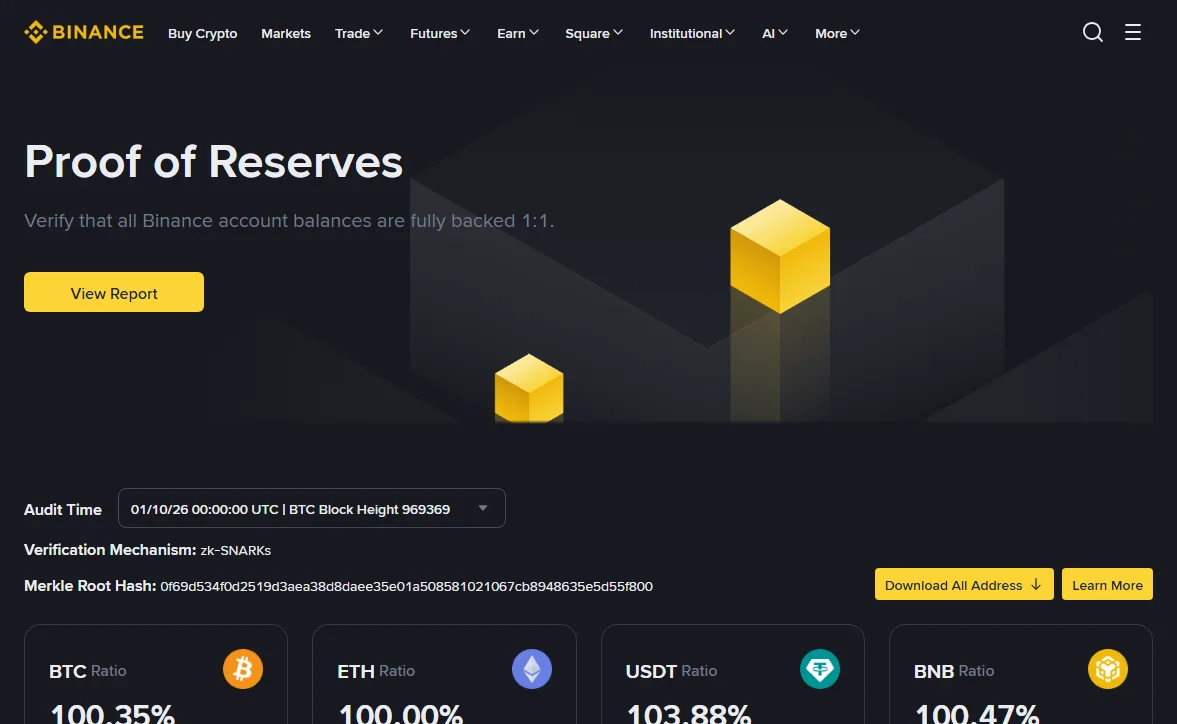
Exchanges publish proof of reserves pages with large green percentages and a phrase like “fully backed 1:1”. Binance's page opens with exactly that line. Underneath it sits something much more specific: a timestamp, a Bitcoin block height, a list of coins, and four numbers per coin.
The ratios compare counted reserves with the account balances included at that moment. Those balances are not necessarily customer holdings alone. A report does not establish the company's total debts, cover unlisted coins or describe events after its snapshot. Read the date, asset list and calculation method before interpreting the ratio.
What the date on a proof of reserves report actually covers
Every figure on the page belongs to one instant. On Binance's page in October 2026, the “Audit Time” selector showed 01/10/26 00:00:00 UTC | BTC Block Height 969369 as the latest entry, in day/month/year order. The same drop-down runs back month by month to a first entry dated 22/11/22, so a holder can see how regularly the snapshots have appeared.
Kraken's page, read on the same day, gave a snapshot date of 30 June 2026. Kraken describes its reviews as regular without fixing an interval here, so by mid-October its newest figures were three and a half months old. Neither page is wrong. They simply answer the question for different days, and a ratio from June says nothing about a withdrawal pause in October.
So before reading any percentage, write down the snapshot date next to it. If a headline or a social post quotes a reserve ratio without that date, the number is incomplete.
What does a reserve ratio of 100.35% mean?
Binance lists four amounts under each coin. For BTC in the 1 October 2026 snapshot:
- Net Account Balances: 688,572.68 BTC. The denominator used for this coin's reserve ratio. Binance's 7 January 2026 methodology update says this figure now includes the platform's own assets, so it must not be read as customer holdings alone.
- Onchain Wallet Balance: 691,003.593 BTC. The reserve side, made of the next two lines.
- Exchange Balance: 679,550.124 BTC in addresses the exchange controls.
- Third-Party Custody: 11,453.469 BTC held with outside custodians but counted toward reserves.
Reserve ratio = (Onchain Wallet Balance ÷ Net Account Balances) × 100. For BTC, 691,003.593 ÷ 688,572.68 × 100 gives approximately 100.353%, displayed as 100.35%. The two listed totals differ by 2,430.913 BTC; that is not a calculation of the surplus over customer liabilities alone.
Now look at ETH in the same snapshot: an Onchain Wallet Balance of 3,799,139.752 ETH against Net Account Balances of 3,799,136.43 ETH. The ratio rounds to 100.00%, and the totals differ by 3.322 ETH. A ratio at or above 100% means the listed wallet amount covers that denominator; it does not identify a cushion above customer liabilities alone.
Headline ratios are poor financial-health rankings because the percentage depends on which balances the method includes. Binance also says the excess assets in its proof of reserves addresses do not indicate its total own assets. In this same dated snapshot, USDT is shown at 103.88% and USDC at 108.26%; these are per-coin readings under that method on that date.
Why “net” balances matter if you use margin or futures
For leveraged accounts, netting also needs care. Binance's technical explanation says a single coin's balance may be negative, while the account's total net value across assets, measured in USD, must be nonnegative for inclusion. That is a rule about the whole account, not a promise that each coin's balance is floored at zero.
Kraken spells out its treatment with examples. A margin position adds a positive adjustment only: buy 1 BTC/USD on margin and your record shows +1 BTC, with no negative adjustment to your USD. Futures collateral gets its own record in the same tree. For single-collateral contracts, unrealized profit or loss adjusts the collateral — 1 BTC with −0.1 BTC unrealized becomes 0.9 BTC — while a multi-collateral position with a USD loss leaves the BTC figure untouched, because USD sits outside the review.
For a spot-only holder none of this changes much. For anyone running leverage, it means the balance shown in your proof of reserves record can differ from the number in your futures wallet, and the method note explains why.
Is my coin covered by the proof of reserves report?
Only listed assets are tested. Binance's first page of cards in the October snapshot covered BTC, ETH, USDT, BNB, SOL, USDC, XRP and USD1, with more pages behind the pager. Kraken's header showed ratios for BTC, ETH, SOL, XRP, ADA, USDC, USDT and USDG.
Check the scope list against the snapshot date you are reading, because lists change. Kraken's own FAQ text named six in-scope assets for its latest round, a shorter list than its ratio header, and the page warns that the starred ratios can change materially as products and custody infrastructure change, which can alter how assets in some wallets are classified. When the header, FAQ and downloadable report disagree, the report for that date is the one to trust.
If the coin you hold is missing, the report is silent about it. That leaves its backing unverified — neither confirmed nor contradicted.
How to check your balance was included in proof of reserves
Both exchanges let a logged-in customer find a personal record for each snapshot.
- Binance: Wallet, then Verification. Pick the verification date; the page lists the verification type, your Record ID, the assets covered and your balances at that time. The Merkle leaf and Record ID let you check that your balance went into the liabilities total.
- Kraken: in Kraken Pro, open the account icon, then Proof of Reserves. Choose a date and press “Verify yourself”. The first 16 characters of your Merkle Leaf ID can also be pasted into the third-party accountant's tool, and the page publishes code for rebuilding the Record ID and leaf hash yourself.
A match proves one thing: your balance on that date was counted on the customer side. Kraken notes its check reflects only in-scope balances at the time of the review, not later trades. If the record shows a balance far from what you held that day, that discrepancy is worth raising with support, with the date and Record ID in hand.
What a proof of reserves report cannot show
Kraken's page carries an unusually frank section on shortcomings, and its points apply to the method in general:
- It proves control of on-chain funds at review time, but cannot rule out that private keys were copied by an attacker.
- It cannot identify hidden liabilities, or prove the funds were not borrowed just to pass the review.
- Keys can be lost, or funds stolen, after the most recent review.
- The result depends on the accountant being competent and independent; otherwise fraud by the audited firm, or collusion, stays possible.
Reserve assets and the included account balances are not a full company balance sheet. A ratio of at least 100% for every listed coin can coexist with debts elsewhere; the proof of reserves comparison does not itemize every corporate obligation. Binance's page states separately that the company has no debt in its capital structure and keeps an emergency fund called SAFU — those are company statements, made next to the report, and the Merkle tree itself does not test them.
When a new proof of reserves report is a reason to look closer
Compare a new report with the preceding one before deciding what needs follow-up. Look for these changes:
- A coin you hold drops below 100%. The counted reserves would be below the reported account total for that coin. Read the method and any announcement explaining the shortfall.
- The snapshots stop. A run of monthly dates that skips a month or two without explanation tells you less than a low ratio, but it is still a gap in the record.
- Your coin leaves the list. Fewer covered assets means less of your holding is being tested.
- The method changes. A new treatment of custody wallets, staking or futures can move ratios without any change in actual holdings, which is what Kraken's starred footnote warns about.
None of these by itself means withdrawals are at risk. If one does coincide with delays, the questions in our guide to why exchanges pause withdrawals take over: what the notice gives as the cause, and whether it names a reopening time. The acronym decoder includes a short definition of SNARK.
Source note
Checked on 18 October 2026 against official exchange materials: Binance “Proof of Reserves”, for the 01/10/26 snapshot, block height, the per-coin balances and ratios quoted, the zk-SNARK checks, the Wallet → Verification steps and the statements about excess assets, debt and SAFU; and Kraken “Proof of Reserves”, for the 30 June 2026 snapshot date, its ratio header, scope, margin and futures treatment, verification steps and the listed shortcomings. The linked Binance methodology update and technical explanation define the balance scope and cross-asset netting used above. These pages update; figures here belong to the snapshots named and will be replaced by later ones. We do not rate exchanges or assess their solvency.