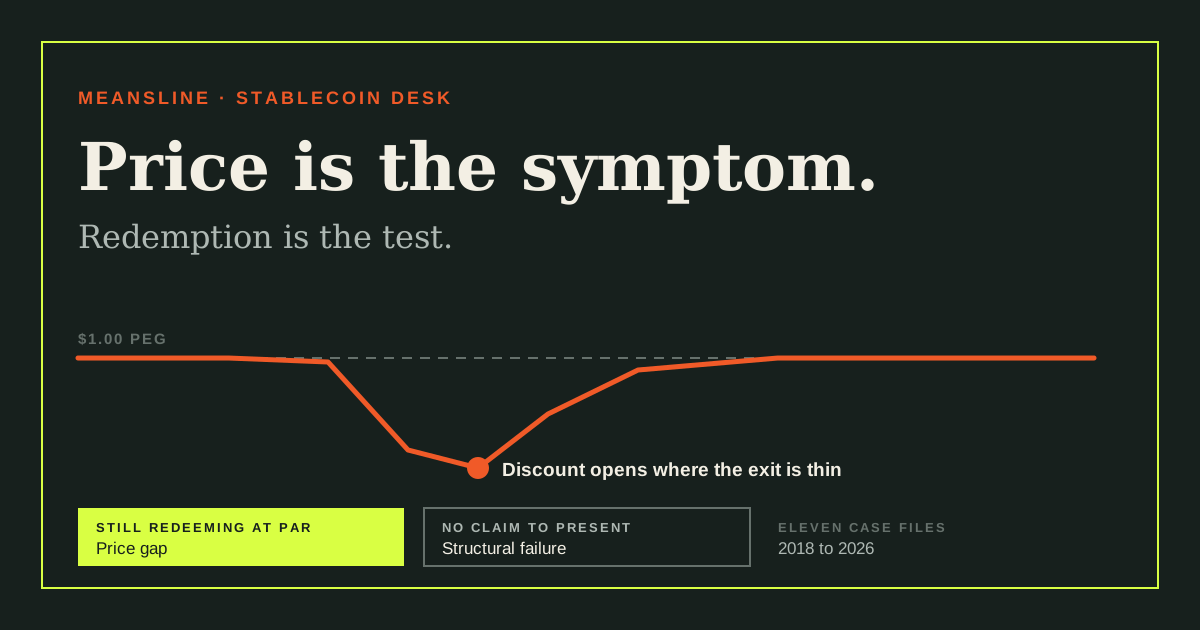
A stablecoin quote of $0.94 produces the same screenshot whether the issuer is having a bad afternoon or has already lost the assets. That is why the price alone is close to useless as a decision input. Two coins can print the same discount on the same day: one because a single banking relationship is frozen over a weekend, the other because the collateral behind it was lent to a fund that no longer has it.
The useful reading starts one layer below the chart. A fiat-referenced stablecoin is a claim on an issuer. Its market price is what an anonymous venue will pay for that claim right now, under whatever liquidity exists in that moment. The peg itself is something narrower and more testable: whether the claim can still be presented to the issuer and settled at par. Those two things move together most of the time, and they come apart precisely in the moments people most need an answer.
This guide builds a mechanism-first reading method and applies it to eleven documented case files between October 2018 and July 2026, including five incidents from the last twelve months. The dataset is a historical record reviewed on 23 August 2026, not a live monitor. The accompanying case-file tool exposes the same records with filters for failure mechanism, year and holder outcome.
Do not ask, “How far below a dollar is it?” Ask, “Who is still obliged to redeem this, with what assets, and is that obligation being performed today?”
The question that actually matters
A price is a venue observation, not a system state
Stablecoin prices are quoted per venue and per pair. A thin automated market maker pool, a single exchange order book with withdrawals paused, and a deep spot pair can all disagree at the same moment. During a scare, the venues that show the worst price are usually the ones where the seller has the fewest options: a pool with shallow liquidity, or a market where the buyer cannot redeem directly and must price the risk of holding.
This is why a headline figure such as “fell to $0.87” needs its venue and its window attached. The number describes where somebody accepted a discount for immediacy. It does not describe the issuer's balance sheet, and it does not tell you whether a redemption submitted in the same hour would have settled at one dollar.
Redemption is the actual peg
For a fiat-referenced coin, the peg is an issuer promise: present the token, receive the reference currency at par. Arbitrage is the mechanism that transmits that promise to the market. If a party can buy the token at $0.97 and redeem it for $1.00, the discount is a profit opportunity that closes as fast as the redemption pipe allows.
A discount therefore tells you something real about that pipe. It may be closed for the weekend, throttled by a wire cutoff, restricted to whitelisted institutional counterparties, or gone entirely. A wide and persistent discount in a liquid market usually means participants have concluded the pipe is not working. A narrow discount that repairs within hours usually means it was working and merely slow.
The three questions that separate the two cases
First: does the backing still exist, and is it identified? A shortfall disclosed with a number, a counterparty and a custody location is a very different situation from a shortfall of unknown size. Second: is redemption being performed right now, for whom, and at what minimum size? Third: is the thing that broke an operational blockage or the design itself?
When all three answers are benign, discounts have historically closed. When any one is unknown, the discount is not a bargain, and its depth is not a measure of the risk. Several of the case files below fell much less than others and returned much less to holders.
Reading rule
Depth of discount does not rank severity. In November 2025 a token that fell roughly 77 per cent ended in a wind-down that aimed to pay holders at par, while tokens that fell far less in other episodes never paid anything.
Five backing designs, five different failure surfaces
1. Fiat-reserve tokens
The issuer holds cash and short-dated government paper against tokens outstanding, and redeems at par. The failure surface is the reserve itself: where it is custodied, how concentrated it is, and whether the issuer can reach it on the day it is needed. Under current frameworks these are the coins with published reserve composition, periodic reporting and named redemption procedures.
This design does not usually fail because the token contract breaks. It fails because a bank holding part of the reserve fails, because reporting proves inaccurate, or because a regulator or court restricts the issuer. USDC in March 2023 is the reference example of a reserve-custody event in which the assets existed and were recovered in full.
2. Overcollateralised crypto-backed tokens
Users lock volatile collateral worth more than the debt they mint. Solvency depends on liquidating that collateral fast enough when its price falls. The failure surface is the liquidation machinery: oracle latency, auction design, network congestion, and whether bidders are present at the exact moment everyone needs one.
These coins can also break upward. When borrowers need the token to close their own positions and supply is constrained, it can trade persistently above par. That is still a peg failure, but it harms borrowers rather than holders. Maker's March 2020 episode produced both effects in the same week.
3. Synthetic and delta-hedged tokens
Backing is a hedged position rather than a bank balance: spot collateral against a short derivatives position, with the peg maintained by the hedge and by a mint and redeem path for approved participants. The failure surface is funding rates, exchange counterparty risk, custody of margin, and the ability to unwind the hedge in a stressed market.
Such an instrument can be well engineered and still is not a deposit. The relevant question is not whether the design is clever, but which venues hold the margin and what happens to the hedge if one of them halts withdrawals.
4. Yield-bearing tokens that are really fund shares
A token marketed as a stable unit while paying a return has to earn that return somewhere. If the strategy is external, discretionary and off-chain, the token behaves more like a share in a managed vehicle than a payment instrument. The failure surface is the strategy and the manager, and the holder frequently can see neither.
The November 2025 sequence made this concrete. A yield-bearing token collapsed after its issuer disclosed a loss at one external manager, and a second token that had placed most of its collateral with the first was wound down days later. Neither failure required the dollar to move at all.
5. Algorithmic and seigniorage tokens
The peg is maintained by minting and burning a second, volatile token rather than by holding reserves. There is no external claim to present. The failure surface is reflexivity: the mechanism that defends the peg dilutes the asset supporting it, so the same feedback loop that absorbs small deviations amplifies large ones.
The May 2022 collapse of UST and LUNA remains the largest example. The SEC alleged that the “algorithmic stablecoin” was marketed as maintaining its peg through interchangeability with LUNA; a jury found Terraform Labs and Do Kwon liable for defrauding investors, and more than $4.5 billion in judgments and settlements followed in 2024.
Eight failure mechanisms and what each one predicts
Reserve custody failure
The reserve exists but is trapped, at a failed bank or a frozen account. Redemption slows or stops while the issuer switches rails. Recovery depends on whether the trapped portion is recoverable and how large it is against the float. This mechanism tends to produce sharp, short discounts and, historically, full recovery once the assets are released.
Counterparty and contagion failure
The backing was lent, deposited or rehypothecated into something that failed. The coin is now a creditor of another entity. Recovery depends on the recovery of that claim, which is usually slow and partial. Discounts persist because the market cannot price an unknown claim, and because holders cannot tell how much of the collateral sits behind the same counterparty.
Collateral and liquidation failure
Collateral exists but cannot be sold at a fair price fast enough. Bad debt appears at the protocol level. Recovery depends on a recapitalisation mechanism, such as auctioning a governance token, and on whether governance chooses to compensate users who were liquidated on unfair terms. Those are two separate decisions and the second is not guaranteed by the first.
Mint-authority compromise
An attacker obtains the ability to issue tokens that no asset backs. Circulating supply exceeds reserves instantly, and the price falls to reflect dilution rather than any loss of the original collateral. The collateral pool can be entirely intact while the token trades at a fraction of par. Recovery depends on burning or blacklisting the illegitimate supply and on the issuer's willingness to honour pre-incident holders.
Oracle manipulation
A price feed is pushed to a false value, which triggers liquidations or mints that the true price would never justify. The damage happens inside the accounting layer, often within a single transaction. Small protocols with one feed, no deviation checks, no maximum drawdown limit and no liquidation delay are the recurring victims.
Redemption gating
The issuer restricts, queues or suspends redemption, or limits it to whitelisted counterparties above a minimum size. This can be operationally reasonable and still destroy the arbitrage that holds the price, because the ordinary seller has no path to par. Read gating notices as peg-relevant even when the issuer presents them as routine. Gating rarely appears as a standalone case, because it usually accompanies one of the other mechanisms; the case-file tool therefore uses algorithmic design in its place as the eighth filter and treats gating as an aggravating factor inside each record.
Confidence and rumour shocks
No mechanism has failed, but a credible-sounding allegation causes concentrated selling. The test is whether redemptions continue at par throughout. FDUSD fell sharply in April 2025 after a public insolvency allegation from a rival; the issuer denied it, redemptions continued to be processed, and the underlying dispute concerned a different token.
Supervisory stop
A regulator halts new issuance while requiring orderly redemption. This is often misread as failure. The February 2023 BUSD notice ordered Paxos to stop minting the token while the department monitored the company to verify that it could facilitate redemptions in an orderly fashion. Supply shrank; the redemption promise held.
What actually broke: reserve, counterparty, liquidation, mint authority, oracle, redemption access, confidence or supervision.
Is the shortfall named with a number and a location, or is the size still unknown?
Is par redemption being performed today, for whom, and with what minimum?
Has anything been minted that no asset backs, and is it being burned or blacklisted?
Who is contractually obliged to make holders whole, and in which jurisdiction?
Recorded separately from the price: restored, wound down at par, partially repaid or unrecovered.
The first hour: a triage sequence that does not require a chart
Start with the issuer's own channel, not with commentary. A fiat-reserve issuer that is still operating will normally publish something within hours, and the useful content is specific: the size of the exposure, where it sits, and whether minting and redemption continue. Circle's March 2023 disclosures are a template for what a usable statement looks like, because they named the amount at the failed bank, the share of total reserves it represented, and the state of the redemption queue day by day.
Second, check whether the supply is still honest. Block explorers show total supply. If supply has jumped by tens of millions in minutes with no corresponding issuer announcement, the event is a mint-authority compromise and the price is reflecting dilution. This is a distinct diagnosis from a reserve problem and it points to a different question: which addresses hold the illegitimate tokens, and can the issuer freeze them?
Third, separate the venue from the instrument. If one exchange shows a deep discount while others do not, ask whether that venue has paused withdrawals of the asset. A frozen exit produces a local discount that has nothing to do with the issuer. The same logic applies to a shallow on-chain pool, where a single large sale can move the quoted price without telling you anything about redeemability.
Fourth, find out who can actually redeem. Many fiat-reserve issuers redeem only for verified accounts above a minimum size. If direct redemption is institutional, the retail holder is dependent on those institutions choosing to arbitrage. In a fast-moving event they may wait, and the discount can persist even though the reserve is fine. This is not a defect to be outraged about; it is a structural fact that should shape expectations about how quickly a peg repairs.
Fifth, look for the word that matters in any wind-down: par. An issuer that says it will redeem outstanding tokens one-for-one, names the snapshot and publishes a claim process is describing an orderly exit. An issuer that says it is “working with partners to assess options” is describing an unknown. Elixir's November 2025 wind-down of deUSD is an example of the first kind of statement, made after the collateral behind it had already been impaired.
Sixth, record the timestamps. Depeg events produce a stream of partially correct claims, and the correction usually arrives after the screenshot has spread. Note when each statement was made and by whom, and keep the issuer's own sequence separate from the aggregated summaries. If you later need to explain a decision, the timeline is the evidence.
Finally, decide what you are actually exposed to. A holder of the token, a lender who accepted it as collateral, a liquidity provider in a pool containing it and a borrower who owes it face four different problems in the same event. Pool providers can end up holding the entire depegged side. Borrowers may benefit from a discount. Lenders may be liquidated by an oracle that has not yet updated, or by one that has updated too aggressively.
Triage rule
Supply integrity, redemption status and venue liquidity are three separate checks. A single price chart cannot distinguish them, and every one of them changes the correct action.
Eleven case files and what each one proves
USDT under scrutiny — October 2018 and the later CFTC order
USDT traded at a visible discount on several venues in October 2018 amid doubts about its banking and reserves. Redemption for eligible direct customers continued, and the discount closed. Three years later the CFTC settled charges that Tether had made untrue or misleading statements about its reserves, ordering a $41 million penalty and finding that from at least June 2016 to February 2019 the tokens were not fully backed by fiat held in Tether's accounts at all times.
The lesson is uncomfortable but useful: a peg can repair while the disclosure problem behind the scare turns out to have been real. Price recovery is not a verdict on reserve quality, and a settled enforcement action years later is a better evidence source than the price chart of the week.
DAI on Black Thursday — 12 to 13 March 2020
A roughly 50 per cent fall in the price of ETH within a day swamped Maker's liquidation auctions while the Ethereum network was congested. Auctions cleared with effectively zero DAI bids, transferring collateral to the few bidders who could get transactions through, and leaving the protocol several million DAI short. Governance recapitalised the system by auctioning newly minted MKR for DAI.
DAI itself then traded above one dollar for an extended period, because borrowers needed DAI to close vaults and supply was constrained. This is the clearest illustration that a depeg is not always a discount, and that the party harmed can be the borrower rather than the holder.
UST and LUNA — May 2022
The largest algorithmic stablecoin lost its peg and the paired token collapsed toward zero within days, erasing tens of billions in market value. The SEC subsequently charged Terraform Labs and Do Kwon with fraud, a jury found them liable in April 2024, and the parties agreed to pay more than $4.5 billion.
The mechanism, not the size, is the lesson. There was no reserve to present and no issuer obliged to redeem at par. Once confidence broke, the stabilising mechanism itself accelerated the collapse. No amount of subsequent litigation returned the peg.
USDC and Silicon Valley Bank — 10 to 13 March 2023
Circle disclosed that $3.3 billion of USDC reserves remained at Silicon Valley Bank when regulators closed it, about 8 per cent of the reserve, with roughly $32.4 billion of the backing in short-dated Treasury bills. USDC traded below a dollar over the weekend while redemption rails were closed. After US authorities confirmed depositors would be made whole, Circle stated the $3.3 billion would be fully available, and the discount closed.
Circle then published a day-by-day operational account: by the close of business on 15 March it had cleared substantially all of the minting and redemption backlog, having redeemed $3.8 billion and minted $0.8 billion of USDC since that Monday morning, while bringing new banking partners online for domestic and international wires.
This case defines the benign end of the spectrum: known exposure, named counterparty, recoverable assets, transparent queue, full repair. It also shows why weekend timing matters. The discount was largest precisely when the redemption pipe was closed for reasons unrelated to solvency.
BUSD and the supervisory stop — 13 February 2023
The New York Department of Financial Services ordered Paxos to cease minting Paxos-issued BUSD over unresolved issues in its oversight of the Binance relationship, while stating that it was monitoring Paxos to verify orderly redemption and placing no restriction on existing BUSD trading in New York by licensed entities.
Holders who read “regulator acts against stablecoin” as “reserve failure” drew the wrong conclusion. The supply wound down over the following period and the redemption promise was performed. A stop on issuance and a failure to redeem are different events with different consequences.
FDUSD and the rumour shock — 2 April 2025
FDUSD fell to roughly $0.87 within hours after a public claim by a prominent industry figure that its issuer was effectively insolvent and unable to meet redemptions. The issuer rejected the claim, stated that FDUSD remained fully backed, and continued processing redemptions, with on-chain data showing tens of millions of dollars of redemptions honoured in the days that followed. The underlying dispute concerned a different token.
The correct test during the episode was not the size of the fall but whether redemption continued. It did. This case belongs in the confidence category, and it is a reminder that allegations from interested parties are not evidence of a reserve shortfall.
xUSD and Stream Finance — 4 November 2025
Stream Finance suspended deposits and withdrawals after disclosing that an external fund manager had lost approximately $93 million of platform assets. Its yield-bearing token xUSD fell roughly 77 per cent toward $0.26, with around $160 million of deposits frozen, and the firm retained outside counsel to investigate.
The token had been presented as a stable unit while its return depended on discretionary off-chain management that holders could not observe. When the manager's loss was disclosed, there was no reserve to inspect and no par redemption to fall back on. Researchers traced roughly $285 million of interconnected exposure across lending markets that had accepted these tokens as collateral.
deUSD and the contagion wind-down — 6 November 2025
Elixir had placed about 65 per cent of deUSD's collateral, roughly $68 million, with Stream Finance. Two days after Stream's disclosure, Elixir announced it would wind down deUSD and redeem holders one-for-one in USDC, disabling mint and redeem infrastructure, snapshotting remaining direct holders and opening a claim process; a large majority of holders had already been redeemed by the time of the announcement.
This is a rare case of a token that failed for reasons entirely outside its own design and still produced an orderly par outcome for holders. It also demonstrates the concentration test: a single counterparty holding most of the collateral is a structural risk regardless of how the token is described.
USR and an infrastructure compromise — 22 March 2026
An attacker reached Resolv's infrastructure through a compromised contractor credential, escalating from repository access to cloud credentials and then to signing authority. Roughly 80 million USR were minted with no backing in two transactions beginning at 02:21 UTC, and about $25 million was extracted as ETH. USR fell below $0.80 within minutes and continued down toward $0.20.
Resolv paused contracts with available pause functions by 05:16 UTC, and its published post-mortem states that narrowly scoped permissions prevented the attacker from touching the collateral pool, that approximately 46 million of the 80 million illegitimate USR were neutralised through burns and blacklisting, and that pre-hack USR holders were compensated one-for-one, with the majority of redemptions already processed.
The collateral was intact throughout, and the price still fell roughly 80 per cent. Anyone who sold into the panic realised a loss that the compensation process would otherwise have avoided. Mint-authority compromise is the mechanism where the gap between market price and holder outcome is widest.
USDR and EURR at StablR — 24 May 2026
An attacker exploited a wallet configuration that required only one of three signatures, added themselves as an administrator, removed the legitimate signers and minted approximately $13.5 million of unbacked USDR and EURR, withdrawing around $2.8 million. The euro token fell toward $0.55 while the dollar token stayed close to par. The issuer froze operations, asked exchanges to suspend trading, notified the Maltese regulator and confirmed that circulating volumes were temporarily not backed one-for-one as MiCA requires.
A MiCA authorisation constrains reserves and redemption. It does not audit a signing threshold. The case is a direct warning against treating a licence as a substitute for operational security, and against assuming that two tokens from the same issuer will move together.
BLC and an oracle attack — 22 July 2026
The algorithmic token BLC fell to fractions of a cent after an attacker fed an abnormal bitcoin price into the protocol's median oracle and used it to liquidate collateral vaults that were not undercollateralised at true prices. Public incident reports identified missing deviation checks, a minimum floor and a liquidation delay; this page does not preserve an uncited loss estimate.
The scale is small, and that is the point: the same class of defect appears in far larger systems. An oracle without bounds is an unbounded authority to liquidate. Where a token has no external redemption path, there is nothing to arbitrage the price back afterwards.
Historical cutoff
These eleven case files were verified against issuer statements, regulatory records and contemporaneous reporting through 23 August 2026. The tool is a historical dataset, not a live peg monitor.
Contained, restored and recovered are three different states
Contained
Containment means the mechanism that caused the loss can no longer operate: contracts are paused, keys are rotated, minting is halted, the attacker's addresses are blacklisted. Resolv's timeline shows containment several hours before any statement about compensation. Containment tells you the hole has stopped growing. It says nothing about who pays for what already went through it.
Restored
Restoration means the service works again: minting and redemption are open, exchanges have resumed deposits and withdrawals, and the token trades near par. Restoration can precede recovery, and it can also arrive without recovery, as when a protocol resumes operating while the losses sit permanently with the users who were liquidated.
Recovered
Recovery is a statement about holders' money, and it is the only one that matters at the end. It requires a named process: a snapshot, a ratio, an eligibility rule and a claim mechanism. Elixir's one-for-one USDC redemption and Resolv's one-for-one compensation for pre-incident holders are recovery statements. A pause notice is not.
Keeping the three states in separate columns prevents the most common misreading of a stablecoin incident, which is treating a reassuring operational update as evidence about final outcomes. The same discipline applies to exchange incidents, and it is the method used throughout our security incident guide.
What the rules now require, and what they do not promise
The regulatory picture changed materially between 2022 and 2026, and it changes what a reader can reasonably expect from a large fiat-referenced issuer. New York's June 2022 guidance set an early template: full backing by a segregated reserve whose market value at least equals the nominal value of outstanding tokens at the end of each business day, custody at US state or federally chartered depositories or asset custodians, and clear redemption policies approved in advance that give any lawful holder a right to redeem at par in a timely fashion.
In the European Union, MiCA brought e-money tokens under a dedicated regime whose rules have applied since 30 June 2024, with issuance restricted to authorised entities and redemption at par as a defining obligation. In the United States, the GENIUS Act was signed into law on 18 July 2025, requiring at least one dollar of permitted reserves for every dollar of payment stablecoin issued, limiting those reserves to instruments such as cash, insured deposits, short-dated Treasury bills and government money market funds, and requiring issuers to establish and disclose redemption procedures with periodic reserve reporting examined by a registered public accounting firm.
Hong Kong's Stablecoins Ordinance regime took effect on 1 August 2025, making the issuance of fiat-referenced stablecoins a licensed activity with requirements covering reserve management, segregation, stabilisation mechanisms and processing redemption requests at par. New York proposed a further regulation on 9 June 2026 to align its framework with the federal statute, including limits on how much of a reserve may sit with any single custodian, which is a direct response to the concentration problem that the 2023 banking episode exposed.
What none of these frameworks promise is that a token you hold is covered by them. Many widely traded tokens are issued outside these regimes, and several of the worst outcomes in this guide involved instruments that were never fiat-referenced payment stablecoins at all. A licence also constrains a defined set of risks: reserve quality, segregation, redemption terms and reporting. It does not certify a multisignature threshold, an oracle configuration or a contractor's laptop, as the May 2026 StablR case demonstrated inside a MiCA-authorised issuer.
The macro-financial view has caught up as well. An IMF working paper published in March 2026 documents that stablecoin demand shocks now transmit into short-term Treasury yields, the dollar, and crypto and equity markets, which is a formal way of saying that these instruments are no longer a niche crypto plumbing question. For a holder, the practical consequence is that regulatory attention will keep increasing and disclosure quality should keep improving, which makes primary sources more useful, not less.
How to verify backing before you need to
Attestation is not audit
Most reserve reporting takes the form of an attestation: an accounting firm reports on management's assertion at a point in time. That is meaningful and it is not the same as an audit of financial statements. Read what the report actually covers, on which date, and by whom. Under the GENIUS Act, issuers above $50 billion outstanding are required to submit audited annual financial statements, which is a step beyond periodic attestation.
Composition, not just the total
A reserve total tells you little. What matters is the split between cash at banks, Treasury bills, repurchase agreements and money market funds, and the maturity of the paper. The March 2023 case turned entirely on composition: the large majority in short-dated Treasuries was never in question, and the problem was the smaller cash balance at one failed bank.
Concentration and custodian names
Ask how much sits with the single largest custodian. Concentration is the variable that converts one institution's failure into your token's discount, and it is the variable New York's June 2026 proposal is aimed at. Where the issuer names its custodians, that is a stronger disclosure than a percentage without names.
Who can redeem, and at what size
Find the redemption policy and read the eligibility and minimum. If redemption is restricted to verified institutional accounts, your practical exit is the market, and the market's price is only as good as the arbitrageurs' willingness to act that day. This single question explains most of the difference between a discount that closes in an hour and one that lasts a weekend.
Supply integrity checks
For on-chain tokens, learn where to see total supply and the mint authority. A supply that can be increased by a small number of signers is a risk that no reserve report captures. After the 2026 incidents, the specific question worth asking about any smaller issuer is how many independent signatures are required to mint, and whether that number is verifiable on-chain.
Read the token, not the ticker
A yield-bearing token with a dollar-like name is not a payment stablecoin. If the marketing describes a return, find the strategy. If the strategy is an external manager, the token is a claim on that manager's performance and the correct comparison is a fund, not a bank balance. Both November 2025 failures were of this type.
Who is the legal issuer, under which regime, and is it the entity named in the marketing?
Composition, maturity, custodians and the concentration at the largest single custodian.
Attestation or audit, as of which date, prepared by whom, and how frequently published.
Who may redeem, at what minimum, in what timeframe, and under what suspension rights.
Where minting authority sits, how many signers control it, and whether freezing is possible.
If the token pays a return, which strategy earns it and which counterparty holds the assets.
Holder decision guide
When doing nothing is defensible
If the issuer is a regulated fiat-reserve issuer, the exposure is disclosed with a number and a location, redemption is being performed, and the discount is a few tenths of a per cent, selling into a thin market converts a temporary gap into a realised loss. The 2023 and 2026 cases both included holders who sold at the bottom of a discount that later closed completely.
When exiting early is the right call
If the size of the shortfall is unknown, if redemption is suspended for everyone rather than delayed, if the backing is a claim on a counterparty that has itself halted withdrawals, or if the token is yield-bearing with an undisclosed strategy, then waiting is not a neutral act. In those cases the discount is an estimate of an unknown, and unknowns in this category have historically resolved badly.
If you are lending or providing liquidity
Your exposure is worse than a holder's. An automated market maker pool converts your balanced position into the depegged asset as others sell. A lending market may liquidate you on an oracle that lags reality, or accept the depegged token as collateral at a hardcoded dollar. The November 2025 contagion spread through exactly these two paths, and the lending markets that had accepted the tokens as collateral froze.
If you are tempted by the discount
Buying a depegged token is a bet that redemption will be performed and that you will be eligible to benefit from it. In a mint-compromise case the pre-incident snapshot may exclude buyers who arrived afterwards, which is precisely how the 2026 Resolv compensation was structured. Read the eligibility rule before assuming a discount is a trade.
If you hold through an exchange
Your claim is against the exchange, not the issuer. The exchange may suspend deposits and withdrawals for the asset, convert balances at a rate it chooses, or delist. Those are product decisions with their own notices, and they are covered by the same reading method as any other exchange announcement in our announcement field guide.
Questions readers ask about depegs
Is a one cent deviation a depeg?
Not in any useful sense. Small deviations reflect venue liquidity and the cost of arbitrage. What matters is persistence and direction of travel: a deviation that widens while redemption is unavailable is a different signal from one that oscillates within a narrow band.
Why do exchanges keep trading a depegged coin?
Internal trading updates the exchange's ledger and does not require the issuer's redemption pipe. That is why trading can continue while deposits and withdrawals of the same asset are suspended. The two statuses describe different systems.
Can a stablecoin trade above a dollar?
Yes, and it is a real peg failure. It typically happens when borrowers must acquire the token to close positions faster than supply can be created. Holders benefit; borrowers pay. DAI did this after March 2020.
Does a regulated issuer mean my money is guaranteed?
No. The frameworks require reserve backing, segregation, disclosure and redemption procedures. They are not deposit insurance, and they do not cover operational compromise of the issuer's own systems.
What does full backing actually mean?
Under the current US statute it means at least one dollar of permitted reserves for each dollar issued, held in a defined list of instruments. It does not mean the reserve is immune to a custodian failure, and it does not mean redemption is instantaneous.
Why did a coin fall 80 per cent when its collateral was intact?
Because unbacked supply was minted. The market prices the ratio of tokens to assets. If the token count doubles and the asset pool does not, the price halves even though nothing was stolen from the pool. The remedy is burning or freezing the illegitimate supply, not selling.
Is the case-file tool a live monitor?
No. It is a verified historical dataset with a 23 August 2026 cutoff. For a live event, use the issuer's own channel, a block explorer for supply, and your venue's status page.
Open the stablecoin depeg case files to filter these records by mechanism, year and outcome, or return to the announcement explainer for the shorter decision card.
Primary and official sources
Meansline reviewed these issuer, regulatory and institutional records on 23 August 2026. Items 1 to 13 are first-party issuer, regulatory or institutional documents. Items 14 and 15 are contemporaneous reports, used where no durable first-party record remains publicly available. The live source controls in every case.
- Circle: $3.3 billion of USDC reserve risk removed, dollar de-peg closes
- Circle: 15 March 2023 update on USDC operations
- NYDFS: Notice regarding Paxos-issued BUSD
- NYDFS: Guidance on the issuance of US dollar-backed stablecoins, 8 June 2022
- NYDFS: Proposed stablecoin regulation aligning with the GENIUS Act, 9 June 2026
- SEC: Charges against Terraform Labs and Do Kwon
- SEC: Terraform and Kwon to pay $4.5 billion following fraud verdict
- CFTC: Order against Tether and Bitfinex, 15 October 2021
- Congress.gov: S.1582, GENIUS Act of 2025
- HKMA: Implementation of the regulatory regime for stablecoin issuers
- Resolv: Post-mortem of the 22 March 2026 incident
- EUR-Lex: Markets in Crypto-Assets Regulation (EU) 2023/1114 summary
- IMF Working Paper WP/26/44: Stablecoin Shocks, March 2026
- The Block: Elixir sunsets deUSD and targets full one-for-one redemption
- CoinDesk: StablR freezes USDR and EURR after $13.5 million unbacked mint