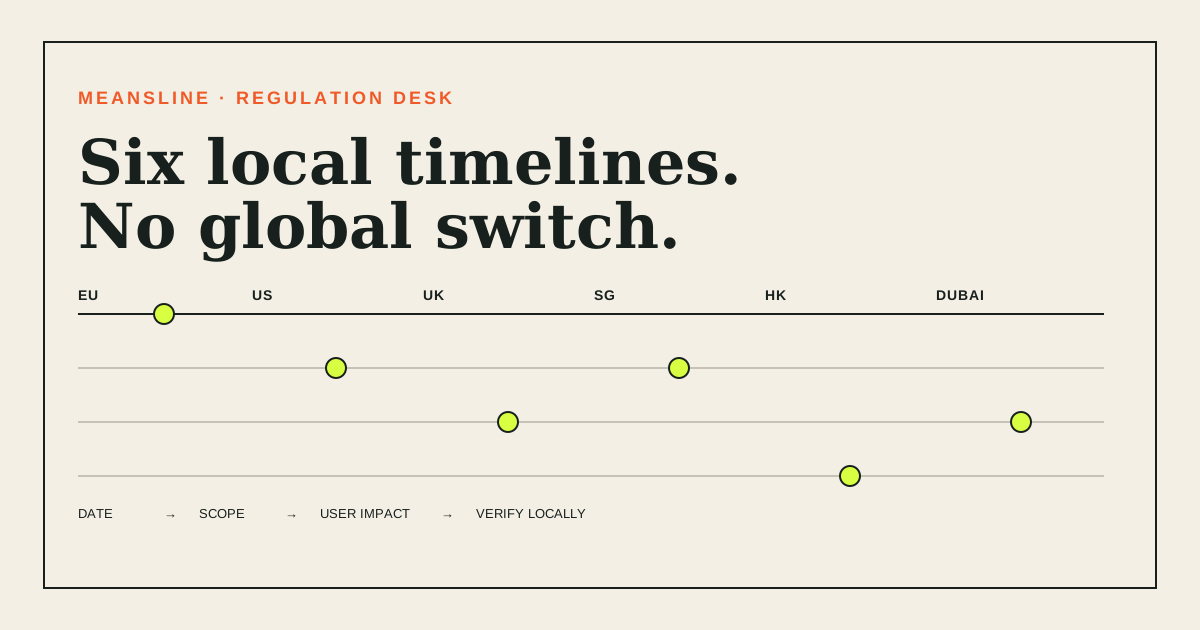
Crypto regulation is often described as if a country flips from an unregulated state to a regulated one on a single day. That framing is attractive and usually wrong. A legislature may define a new activity years before the detailed rulebook applies. A marketing restriction can take effect before a licensing regime. Stablecoin issuers can receive one set of obligations while exchanges, custodians and investment products remain on separate legal tracks.
The result is a collection of local timelines rather than one global race. On the same date, an exchange may be licensed for one activity in one place, marketing under restrictions in another, serving only professional clients somewhere else, and unavailable in a fourth market. A product called a stablecoin may fall within an issuer regime, a payments regime or neither, depending on its design and the user's location.
This guide follows six important regulatory tracks through 23 August 2026: the European Union, United States, United Kingdom, Singapore, Hong Kong and Dubai. It uses enacted law, regulator statements and official rulebooks. It does not score jurisdictions as friendly or hostile, and it does not treat a consultation, speech or political proposal as law.
A regulatory headline becomes useful only after you attach four labels: jurisdiction, activity, effective date and affected user.
How to read this timeline
Each milestone below answers the same questions. First, what document or decision actually appeared? Second, when did its relevant provisions take effect? Third, which activity did it cover? Fourth, what could an ordinary user notice in a product, account or disclosure?
Those questions prevent three common errors. The first is confusing adoption with application. The European Union's Markets in Crypto-assets Regulation entered into force in June 2023, but its stablecoin provisions applied from June 2024 and the remaining regime from December 2024. Those are three legitimate dates describing three different legal stages. A headline that reports only one of them can be technically correct and still misleading.
The second error is confusing an entity rule with an asset endorsement. A regulator can license a platform, register a firm for anti-money-laundering purposes or permit the listing of an exchange-traded product without declaring the underlying token safe. Regulatory status may tell you something important about oversight and permitted activity. It does not remove volatility, technology, custody, fraud or counterparty risk.
The third error is exporting a local result. Hong Kong's rules govern activity in or marketed into Hong Kong. Dubai VARA's authority covers Dubai's mainland and free zones except the Dubai International Financial Centre. An EU authorization has a specific European passporting logic. None of those facts creates a worldwide permission.
The legal text has completed a formal approval stage. It may not yet apply.
The law exists in the legal order, often after publication, but some provisions may have later application dates.
The relevant obligations begin to govern the stated activity, subject to transition provisions.
A named firm has permission for stated activities and conditions. The status does not attach to every affiliate or product.
A firm appears on a regulator's register for a stated perimeter. Registration may be narrower than full prudential or conduct authorization.
An official future date has been announced. It remains a future milestone until it arrives.
We also distinguish rules from enforcement and market structure. A rule can exist even when no case has tested its boundaries. Enforcement can clarify a regulator's view without creating the whole framework. A market event, such as the approval of spot bitcoin exchange-traded products in the United States, can be highly consequential while remaining narrower than a comprehensive crypto law.
European Union: a staged, cross-market framework
29 June 2023 — MiCA entered into force
The EU's Markets in Crypto-assets Regulation, usually called MiCA, entered into force on 29 June 2023. MiCA created a harmonized framework for types of crypto-assets and services that were not already covered by other EU financial-services law. Its structure includes rules for issuers of asset-referenced tokens, issuers of e-money tokens, other crypto-asset offers and admissions to trading, and crypto-asset service providers.
Entering into force did not mean every obligation applied that morning. It established the regulation and started the path toward staged application. National authorities, European supervisory bodies and firms still needed technical standards, authorization work and transition planning. For a user, the immediate practical lesson was to expect a common EU vocabulary and authorization framework, not instant uniformity across every account.
MiCA also illustrates the importance of legal perimeter. Crypto-assets that qualify as financial instruments under existing EU law are generally handled under that existing framework rather than being pulled wholesale into MiCA. The label “token” therefore does not decide the legal category. Rights, design and use matter.
30 June 2024 — stablecoin titles began to apply
MiCA's rules for asset-referenced tokens and e-money tokens applied from 30 June 2024. These categories are often grouped under the everyday word stablecoin, but the legal distinction matters. An e-money token purports to maintain a stable value by referencing one official currency. An asset-referenced token uses another value, right or combination, potentially including more than one currency or other assets.
The issuer rules address authorization, disclosures, governance, reserve assets, redemption and supervision. Requirements can become more demanding for tokens classified as significant. For ordinary users, this milestone could surface as changes to availability, issuer documentation, redemption terms, exchange listings or product restrictions. A platform's decision to limit a token in a region may reflect its reading of the issuer's status and the service it offers, not a claim that the token has failed technically.
This is also why “MiCA compliant” deserves a follow-up question. Is the claim about an issuer, a white paper, a crypto-asset service provider or a specific service? Is the authorization final, transitional or limited? A broad marketing phrase can compress several different legal requirements into two words.
30 December 2024 — the remainder of MiCA applied
The rest of MiCA applied from 30 December 2024. This brought the crypto-asset service-provider framework and rules for other covered crypto-assets into application. Services within the framework include custody and administration, operation of a trading platform, exchange, execution, placing, transfer services, advice and portfolio management, depending on the exact definitions and permissions.
A central benefit of the EU structure is that an authorized provider can operate across the Union through the regulation's cross-border framework, subject to its authorization and notifications. That does not mean every product is available in every member state or to every customer. Firms can narrow their offerings, and national transition measures can affect how pre-existing providers move into MiCA authorization.
For users, the authorization record becomes a more useful fact than an exchange homepage badge. Check the legal entity, home regulator and permitted services. A group brand can contain multiple companies. The entity holding customer assets or providing the trade may differ by residence. If the entity in the terms does not match the entity in an official register, the discrepancy deserves attention.
17 January 2025 — DORA added operational-resilience duties
The EU's Digital Operational Resilience Act, DORA, applied from 17 January 2025. DORA is not a crypto-only law, but it matters to financial entities within its scope, including authorized crypto-asset service providers. It sets a common framework for information and communication technology risk, incident reporting, resilience testing and third-party risk.
The practical effect is not a promise that outages will disappear. Operational-resilience regulation is about governance, controls, testing, reporting and recovery capacity. A licensed service can still suffer an incident. The user-facing signal is that an outage or cyber event may trigger documented regulatory processes in addition to the provider's technical response.
United States: product decisions and federal statutes on separate tracks
The United States does not fit neatly into a single comprehensive federal crypto-asset statute for every token, platform and service. Securities, commodities, derivatives, banking, payments, money transmission, tax and state law can overlap. That fragmented structure makes precise nouns especially important. A court ruling about one transaction, a registration question for one intermediary and an approval for one exchange-traded product do not automatically settle the legal status of all crypto activity.
10 January 2024 — spot bitcoin exchange-traded products approved
On 10 January 2024, the US Securities and Exchange Commission approved rule changes that allowed the listing and trading of shares of spot bitcoin exchange-traded products. The decision expanded the ways eligible brokerage customers could obtain bitcoin price exposure through exchange-traded securities. It did not approve bitcoin itself, endorse the asset, declare crypto trading platforms compliant or decide the status of every other token.
The SEC chair's statement at the time stressed the narrowness of the action. The approval concerned specified exchange filings for commodity-based trust shares holding bitcoin. Investors in those products own shares under the product's legal structure; they do not receive a private key or the ability to transfer the underlying bitcoin on-chain. Fees, tracking, share creation and redemption mechanics, custody arrangements and brokerage rules remain part of the product analysis.
For an ordinary user, the practical change was access through traditional securities accounts. That can simplify reporting and custody decisions for some investors, but it also changes the rights. A fund share is not interchangeable with self-custodied bitcoin. The trading day, settlement system and intermediaries differ from a continuously operating blockchain market.
18 July 2025 — the GENIUS Act became law
Public Law 119-27, commonly referred to as the GENIUS Act, was enacted on 18 July 2025. It created a federal framework for payment stablecoins and permitted payment stablecoin issuers, including reserve, disclosure, redemption, supervision and anti-money-laundering provisions. The statute also contains implementation timelines and agency rulemaking work, so enactment is not identical to every operational requirement being complete.
The law's subject is narrower than “all stablecoins” in casual conversation and far narrower than all crypto. Its definitions focus on payment stablecoins and permitted issuers. A token described in marketing as stable may be outside that definition, prohibited from issuance by an unauthorized person or governed by other law. Users still need to identify the issuer, the redemption claim and the governing terms.
Reserve requirements can improve the quality and transparency expected of a permitted issuer, but they do not make every secondary-market price immovable. A stablecoin can trade above or below its reference value when redemption access, market liquidity, operational availability or confidence changes. The legal right and the exchange price are connected but not identical.
The federal framework also sits alongside state roles and other federal authorities. The exact supervisory path can depend on the issuer type and size. A bank subsidiary, federal qualified issuer and state qualified issuer do not necessarily have the same supervisor. Users should resist turning “regulated in the US” into a single badge without asking who regulates what.
Why enforcement headlines are not a complete timeline
US crypto coverage often builds timelines from complaints, settlements and court decisions. Those events matter, but they answer questions tied to their facts and procedural posture. A complaint states an agency's allegations. A settlement may resolve a matter without creating a generally applicable appellate precedent. A district court opinion can be appealed or distinguish one type of transaction from another.
For this guide, the two federal milestones above were selected because their official status and user-facing scope are clear: a product-listing decision and an enacted stablecoin statute. They should not be combined into a claim that all US crypto has one licensing regime. When reading a US headline, identify whether the subject is an issuer, token sale, exchange, broker, futures product, bank, money transmitter or investment product.
United Kingdom: marketing rules first, broader regime scheduled
29 June 2023 — the Financial Services and Markets Act received Royal Assent
The Financial Services and Markets Act 2023 received Royal Assent on 29 June 2023. Among a much broader set of financial-services reforms, it gave the UK a route to bring activities involving certain cryptoassets and stablecoins used in payments into the regulatory perimeter through secondary legislation and detailed rules.
Royal Assent was a foundational legal milestone, not the date on which every crypto service became fully authorized under a new regime. The act supplied powers and legal architecture. Consultations, legislation, regulator rules, authorization applications and commencement dates still needed to follow.
8 October 2023 — the crypto financial-promotion regime took effect
From 8 October 2023, the UK's financial-promotion regime applied to qualifying cryptoasset promotions to UK consumers. The FCA states that the regime applies to firms marketing cryptoassets to UK consumers regardless of whether the firm is based in the UK or overseas. Promotions must use one of four lawful routes and comply with conduct standards, including requirements that communications be fair, clear and not misleading.
User-facing effects can include prominent risk warnings, changes to incentives, a cooling-off period for certain first-time investors, client categorization and appropriateness questions. These frictions do not mean the underlying asset has received FCA approval. They govern the way the investment is promoted and the path through which a consumer proceeds.
The distinction between marketing permission and firm authorization is critical. A promotion approved by an authorized person is not the same as the crypto business itself holding a future crypto authorization. A firm registered with the FCA under money-laundering regulations is not automatically authorized for every financial service. The label on the page should be traced to its legal route.
25 October 2027 — official start date for the new regime
The FCA's current registration guidance states that the UK's new regulatory regime for cryptoasset firms is due to start on 25 October 2027. As of this guide's review date, that is a scheduled future milestone, not an event that has already happened. Firms seeking to conduct newly regulated cryptoasset activities will need to navigate the application and transition process described by the authorities.
Until that future date arrives, readers should not write about the new regime in the past tense. The existing promotion rules and anti-money-laundering registration perimeter continue to be relevant, but they are not substitutes for the future authorization framework. Any schedule can also be affected by final legislation or official implementation updates, so the live FCA page remains the controlling source for planning.
Singapore: the payment-services perimeter expanded
Singapore regulates digital payment token services within the Payment Services Act framework. The legal term digital payment token, or DPT, has a defined scope. It should not be assumed to cover every digital asset, every tokenized security or every blockchain service. The Monetary Authority of Singapore's Financial Institutions Directory provides the current public route for checking institutions and licensed activities.
4 April 2024 — amended DPT-service scope commenced
The Payment Services (Amendment) Act 2021 came into operation on 4 April 2024. The accompanying 2024 regulations expanded regulated DPT-service activities, including certain transmission or arrangement services and custodial functions. The text can capture activity even when the service provider does not come into possession of money or DPTs, and it can address transfers between accounts in Singapore or elsewhere.
This matters because a business model can present itself as “only arranging” a transfer or “only safeguarding” access while still performing a regulated service. Legal scope follows the defined activity, not the marketing description. Providers newly brought into scope could rely on specific transitional exemptions if they met notification and application conditions; those exemptions were not permanent licences.
For users, the practical task is to verify the exact institution and activity in the MAS directory. A major global brand may use different entities for different countries. A licence held by one company does not automatically cover an affiliated company named in another set of terms. The directory is also more reliable than a logo, influencer statement or app-store description.
4 October 2024 — additional safeguarding provisions commenced
Parts of the Payment Services (Amendment) Regulations 2024 took effect on 4 October 2024. These included detailed requirements relevant to safeguarding customer assets for DPT service providers, such as trust-account arrangements, controls, books and records, statements and disclosures under the amended regulations.
Safeguarding is not the same as deposit insurance and should not be described that way. Segregation and trust arrangements aim to reduce misuse and clarify treatment, but legal recovery can still depend on facts, records, insolvency proceedings and the nature of the asset. Users should read the provider's custody terms and risk disclosures rather than assuming that “regulated” means government-guaranteed.
Singapore's timeline demonstrates why implementation dates can be split. One set of amendments expanded which services were regulated in April; another set of operational requirements began in October. A timeline that records only the act's original passage in 2021 misses when firms and users actually encountered the revised perimeter.
Hong Kong: platform licensing and stablecoin issuance are separate
1 June 2023 — VATP licensing regime commenced
Hong Kong's new licensing regime for centralized virtual asset trading platforms took effect on 1 June 2023. Platforms carrying on a business of operating a virtual asset exchange in Hong Kong, or actively marketing such services to Hong Kong investors, came within the Securities and Futures Commission licensing framework under the Anti-Money Laundering and Counter-Terrorist Financing Ordinance.
The SFC's rules address areas including custody, client-asset segregation, token admission, conflicts, cybersecurity and market conduct. Licensed platforms can serve retail investors subject to the applicable controls and the platform's own approved scope. That does not make every token available. A platform applies its admission process, and products can remain restricted by jurisdiction or client type.
Transitional arrangements allowed qualifying pre-existing platforms to continue for a period and, if conditions were met, to be deemed licensed while an application was assessed. The SFC expressly warned that a deemed-to-be-licensed applicant was not the same as a fully licensed platform and might not ultimately receive a licence. The ordinary-user lesson is simple: status labels must be read literally.
1 June 2024 — non-contravention period ended
The initial non-contravention period for pre-existing platforms ended on 1 June 2024. Platforms without a valid path under the deeming arrangement were expected to cease Hong Kong operations. The milestone made the public lists of licensed platforms, deemed applicants, closing platforms and suspicious platforms especially important.
A user should check the SFC's current lists immediately before opening or funding an account. Historical status is not enough because an application can be withdrawn, returned, refused or approved after an older article was published. A platform's offshore licence does not replace a Hong Kong licence when the local activity falls within the Hong Kong perimeter.
1 August 2025 — stablecoin issuer regime commenced
Hong Kong's Stablecoins Ordinance and the Hong Kong Monetary Authority's supervisory framework for licensed stablecoin issuers took effect on 1 August 2025. The regime focuses on fiat-referenced stablecoin issuance within its statutory scope and includes licensing, reserve-asset management, redemption, governance, risk management, disclosure and anti-money-laundering requirements.
This is an issuer regime, not an automatic platform licence. A company licensed to operate a virtual asset trading platform by the SFC and a company licensed to issue a fiat-referenced stablecoin by the HKMA hold different permissions from different regulators. One firm could need more than one permission depending on its business.
For users, an issuer licence can provide a clearer route to official information about reserves, redemption and governance. It still does not make all stablecoins equivalent or eliminate secondary-market price risk. Verify whether the particular token and issuing entity are within the licence rather than extrapolating from a group name.
Dubai: an activity-based VARA framework
Dubai's Virtual Assets Regulatory Authority, VARA, regulates virtual assets across Dubai's mainland and free zones except for the Dubai International Financial Centre, which has its own regulatory system. That geographic exception is essential. Saying “UAE licensed” can obscure whether the permission is from VARA, the DIFC's DFSA, another emirate's authority or a federal authority.
7 February 2023 — Virtual Assets and Related Activities Regulations issued
VARA issued its Virtual Assets and Related Activities Regulations 2023 on 7 February 2023. The framework established licensing and supervision for virtual asset service providers and linked general compulsory rulebooks with activity-specific rulebooks. Regulated activities include advisory, broker-dealer, custody, exchange, lending and borrowing, management and investment, and transfer and settlement services, along with issuance requirements.
The activity-based design means a licence is not a blanket permission. A provider approved for custody does not automatically have exchange or lending permission. The official public register and licence conditions should show what the legal entity may do. Marketing in or targeting Dubai also has its own regulatory requirements; a promotion does not prove that every advertised service is licensed.
19 June 2025 — Version 2.0 compliance deadline
On 19 May 2025, VARA announced Version 2.0 of its activity-based rulebooks and set a transition period for affected providers, with full compliance required by 19 June 2025. The update strengthened or clarified controls in areas including margin trading, token distribution, collateral wallets, client protection, market integrity and operational resilience.
The update is a reminder that a licence exists inside a changing rulebook. A provider can remain licensed while its obligations are revised. Users may see changes to terms, eligibility, collateral treatment, disclosures or product availability as a firm implements updated rules. Those changes do not necessarily signal distress; they may reflect a new compliance requirement.
VARA's framework also shows why dates should attach to versions. A summary written from the original 2023 rulebook may no longer capture later requirements. The official rulebook portal records current text and revisions. When a decision depends on a specific rule, check the version and effective date rather than relying on a static third-party table.
What the six regimes do—and do not—have in common
All six timelines move toward identifiable entities, defined activities, official registers and clearer customer-facing obligations. That shared direction can make the regimes look more alike than they are. Their legal architecture, product categories, transition periods and division of responsibility remain different.
The EU built a broad supranational framework for covered crypto-assets and service providers, with a separate but connected operational-resilience law. The United States produced important federal product and stablecoin milestones while retaining overlapping agency and state roles. The United Kingdom applied promotion controls before its broader authorization regime. Singapore expanded a payments-based perimeter. Hong Kong separated platform and stablecoin issuer regimes between two regulators. Dubai uses VARA's territorial and activity-based framework.
Ask whether the token or service falls within MiCA, which entity is authorized, and whether a national transition applies.
Name the product and authority. An ETP, payment stablecoin, spot platform and derivatives venue sit on different tracks.
Separate financial-promotion compliance, anti-money-laundering registration and the future crypto authorization regime.
Check the legal entity and licensed DPT service in the MAS directory; a transitional exemption is not a licence, and safeguarding is not deposit insurance.
Use the SFC for platform status and the HKMA for fiat-referenced stablecoin issuer status.
Confirm VARA jurisdiction and each permitted activity; remember that the DIFC is outside VARA's territory.
Licensing reduces some uncertainties, not all risk
A licensing framework can set capital, governance, custody, disclosure, conduct, technology and complaint-handling standards. It can create supervisory access and enforcement consequences. Those are meaningful protections. They do not promise that an asset will retain value, a smart contract will work, an account will never be frozen or a firm will never fail.
Regulation also does not eliminate operational discretion. A compliant exchange can delist an asset, pause a network, limit a product or ask for additional verification. A licensed stablecoin issuer can operate under redemption rules that differ from instant selling on an exchange. An exchange-traded product can track an asset imperfectly after fees.
Stablecoin is an economic description, not one legal category
The EU distinguishes asset-referenced tokens and e-money tokens. The US federal law defines payment stablecoins. Hong Kong regulates in-scope fiat-referenced stablecoin issuers. Singapore's DPT framework addresses service providers and can interact with separate payment concepts. Dubai's issuance rulebook includes fiat-referenced and asset-referenced virtual assets. Similar economic promises can therefore lead to different legal classifications.
Before relying on a stablecoin regulation headline, identify the reference asset, issuer, redemption right, reserve arrangement, holder eligibility and distribution chain. A token can be issued under one jurisdiction, held by a custodian in another and traded by a user in a third. Each link may introduce a separate legal relationship.
Marketing controls are not product approval
The UK's financial-promotion rules make this especially visible, but the distinction applies broadly. A compliant advertisement should give required risk information and avoid misleading claims. It does not convert the advertised token into an approved investment. Likewise, a regulator's public register confirms a stated status; it is not a recommendation to use the firm.
Transition labels deserve the same attention as licences
MiCA national transitions, Singapore exemptions, Hong Kong deemed status and future UK application windows all demonstrate the same issue. A firm can operate legally during a transition without holding the final long-term permission. That status can be valid and still less settled than full authorization. Record both the label and its expiry or review condition.
A practical regulatory check for ordinary users
A useful check begins with the footer or terms, not the brand name. Find the legal entity that contracts with residents of your country. Record its company name and, if shown, registration or licence number. If the terms route different products through different affiliates, write down the entity for the specific product you plan to use.
- Name your jurisdiction. Residence, location and customer classification can all affect availability. Do not assume the rules shown to a friend apply to your account.
- Name the activity. Trading, custody, staking, lending, transfer, advice, issuance and derivatives can require different permissions.
- Find the official register. Navigate from the regulator's own domain. Search the legal entity, not only the brand.
- Match the permission. Confirm that the listed activity covers what you intend to do. A custody permission does not automatically cover lending.
- Read the status word. Licensed, authorized, registered, exempt, deemed, applicant and withdrawn are not synonyms.
- Check the date. Verify that the status is current and that any transition has not ended.
- Read asset-specific terms. Platform authorization does not mean every listed token or service carries the same protection.
- Save the evidence. Keep the regulator page, product terms and relevant announcement date for your records.
If you cannot connect the brand to the legal entity, stop before funding. If the entity is present but the activity is missing, ask what permission covers the service. If the provider cites an overseas licence, check whether that licence is relevant to marketing or serving users in your location.
Red flags include a regulator logo without an entity name, a licence number that belongs to another company, the word “regulated” without an activity, a claim that a pending application equals approval, or a statement that regulation guarantees returns or recovery. A genuine licence can be explained precisely.
There is also a limit to registry checking. A fraudulent site can impersonate a licensed firm. Compare the regulator's contact details, approved domains and official warnings where available. Reach the platform through an address you independently verified rather than a link in an unsolicited message.
The four-line note
Write: “My entity is ____. The regulator is ____. The permitted activity is ____. Status checked on ____.” If any blank remains, the regulatory claim is not yet useful.
The next known date: 25 October 2027 in the UK
The clearest scheduled future milestone in this edition is 25 October 2027, the date the FCA says the UK's new cryptoasset regulatory regime is due to start. It belongs in a forward calendar, not in a list of completed events. Between now and then, final rules, application windows and transition instructions may add more dates.
This guide deliberately avoids guessing which jurisdiction will act next. Consultations, bills and speeches are valuable signals, but they can change. When an official body publishes a binding date or an enacted measure, it can be added with the same four labels: jurisdiction, activity, effective date and affected user.
The accompanying regulation timeline tool turns the completed and scheduled milestones into filterable cards. It is a static research aid with a visible cutoff date, not a live compliance service.
Questions readers ask about regulation timelines
Which country regulated crypto first?
That question needs a definition of regulated. Countries introduced tax treatment, anti-money-laundering duties, securities enforcement, payments licensing and bespoke virtual-asset frameworks at different times. A single winner hides the activity being measured. A better question is: when did this jurisdiction begin regulating this specific service or product?
Does a licence mean my funds are insured?
No. Licensing and insurance are separate. Some regimes require segregation, safeguarding, reserve assets or capital, but those measures are not automatically equivalent to bank-deposit insurance. Check the provider's legal terms and the relevant statutory scheme.
Can one exchange licence cover the whole world?
No. Permissions have territorial, entity and activity boundaries. A group may hold several licences through several affiliates. The contract for your account determines which entity matters, while local law determines whether that entity may serve you.
Does regulation decide whether a token is a good investment?
No. Regulation can improve disclosures and intermediary standards, prohibit conduct or limit availability. It does not set a guaranteed fair value or future return. Product approval and investment merit are different questions.
Why do dates in other timelines disagree?
Authors may choose the adoption date, publication date, entry-into-force date, application date or transition deadline. The disagreement may disappear when each date is labeled. If two sources still conflict, the enacted text and regulator's official implementation notice should carry more weight than a summary.
How often should I recheck a status?
Check immediately before opening an account, transferring material value or using a new regulated activity. Recheck after a major terms change, regulatory notice or long period of inactivity. This page records a research cutoff of 23 August 2026; it is not evidence of status after that date.
2 October 2026 clarification: the VARA transition paragraph now uses the announced compliance date without restating the period as a day count. This does not update the historical timeline as a whole.
Official sources
Meansline reviewed these primary legal and regulator sources on 23 August 2026. The guide summarizes them for education and is not legal advice.
- EUR-Lex: Markets in Crypto-assets Regulation summary and application dates
- European Commission: MiCA and DORA application timeline
- US SEC: Statement on spot bitcoin exchange-traded product approval
- US Congress: Public Law 119-27, GENIUS Act
- UK FCA: Cryptoasset financial promotions to UK consumers
- UK FCA: Registration and the scheduled new crypto regime
- Singapore Statutes Online: Payment Services (Amendment) Regulations 2024
- Monetary Authority of Singapore: Financial Institutions Directory for DPT services
- Hong Kong SFC: Implementation of the VATP licensing regime
- Hong Kong Monetary Authority: Stablecoin issuer regime and supervisory guideline
- Dubai VARA: Virtual Assets and Related Activities Regulations 2023
- Dubai VARA: Version 2.0 activity rulebooks and compliance date